Educational Activity

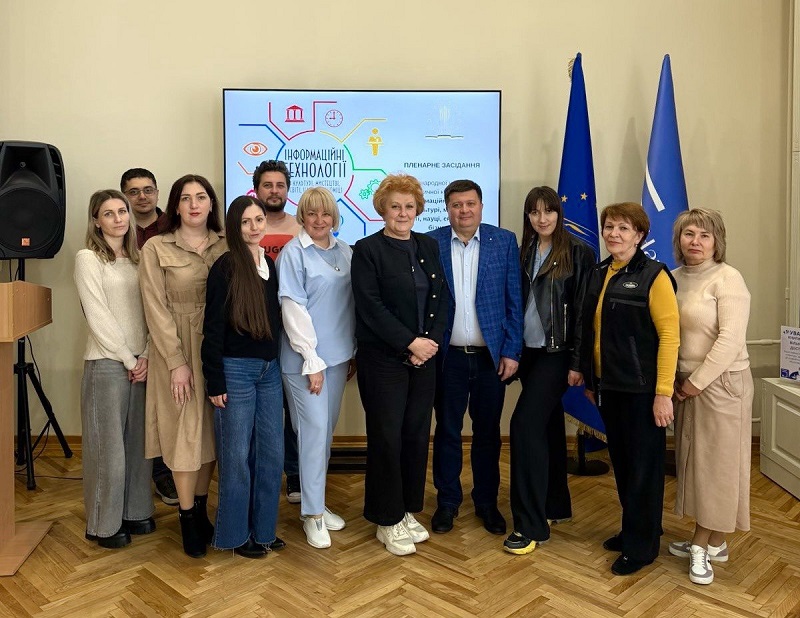
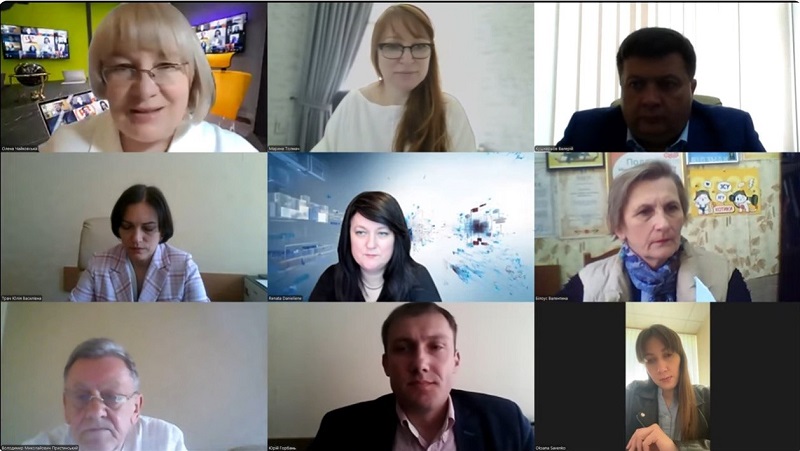
On May 13-15, 2026, UAITP members O. Chaikovska and M. Tolmach participated in two international conferences: the 11th International Scientific and Practical Conference "Information Technologies in Culture, Art, Education, Science, Economics and Business" and the 10th International Scientific and Practical Conference of Students and Young Scientists "Information Technologies in the Socio-Cultural Sphere, Education and Economics," held at the Kyiv National University of Culture and Arts. The conferences brought together more than 120 scientists, educators, and representatives of professional communities from Lithuania, Poland, Canada, and various regions of Ukraine.
Yuliia Trach, Vice-Rector for Scientific and Methodological Work, Doctor of Culturology, and Professor at the Kyiv National University of Culture and Arts, addressed the conference participants with a welcoming speech. In her address, she emphasized that every opportunity to continue learning, research activities, generating new ideas, and maintaining professional dialogue and international academic cooperation is of particular value. Holding the conference under the conditions of a full-scale invasion is not only a scientific event but also a testament to the resilience of Ukrainian science, education, culture, and art. Yuliia Trach noted the breadth of the thematic spectrum of the reports, which cover issues of digital transformation in education and culture, as well as the challenges of artificial intelligence, immersive technologies, cybersecurity, and the development of digital competencies.
On behalf of the organizing committee, Valerii Kushnarov, Candidate of Culturology, Professor, and Dean of the Faculty of PR, Journalism and Information Policy at the Kyiv National University of Culture and Arts, welcomed the conference participants. In his speech, he emphasized the importance of live academic communication during conferences, while noting that due to the actions of the aggressor country, the event had to be moved to an online format. He specifically highlighted that holding such scientific events has become a steady and good tradition for the faculty.
Halyna Kolomoiets, Candidate of Pedagogical Sciences and Deputy Director of the State Scientific Institution "Institute for the Modernization of Educational Content," focused on the fact that in the conditions of the pandemic and the war, digital skills have become a key tool for professional activity, learning, and communication. According to her, the use of artificial intelligence, the creation of interactive presentations, and video content are basic digital competencies today. She also noted the successful experience of the Kyiv National University of Culture and Arts in implementing digital innovations in arts education.
In his welcoming speech, Yurii Horban, Candidate of Culturology, Professor, and Head of the Department of Information Activity and Public Relations, emphasized that the key task of the scientific community is to find research approaches that have practical value and contribute to solving current social, cultural, and communication challenges.
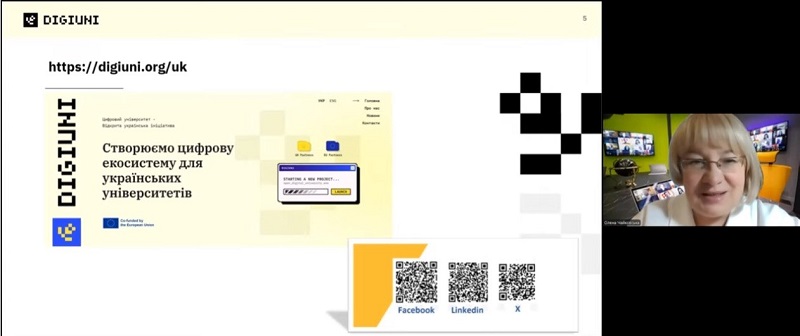
UAITP Vice-President Olena Chaikovska spoke at the Plenary Session with a report titled "Digital University - Open Ukrainian Initiative." In her speech, she presented the DigiUni project as one of the most large-scale initiatives currently being implemented in Ukraine in the field of higher education. She noted that the project is aimed at supporting the functioning and development of universities during wartime, as well as their further recovery in the post-war period. The consortium includes 21 full partners, including Ukrainian higher education institutions and European universities, as well as 5 associate partners, including the Ministry of Education and Science and the Ministry of Digital Transformation of Ukraine. The project is implemented within the framework of the KA2 Capacity Building in Higher Education program and belongs to structural projects aimed at supporting systemic reforms. Its implementation period covers 2023–2027, and the coordinator is Taras Shevchenko National University of Kyiv. The key goal of the project is to create an open digital educational environment for Ukrainian universities. DigiUni serves as a response to the challenges caused by the armed aggression of the Russian Federation and the significant losses suffered by Ukraine's higher education system. At the same time, the project is intended to ensure the integration of European experience in the field of digital solution development and to promote deeper cooperation between Ukrainian and European universities. Currently, a large-scale stage of academic staff preparation is being completed, a phase of intensive training for trainers who will subsequently coordinate the creation of innovative educational content for the DigiPlatform. The training program is multi-level and covers various target categories:
The ultimate goal is to form a powerful community of over 600 certified participants who will train colleagues, create, administer, and evaluate the quality of digital courses for the DigiPlatform in accordance with European standards.
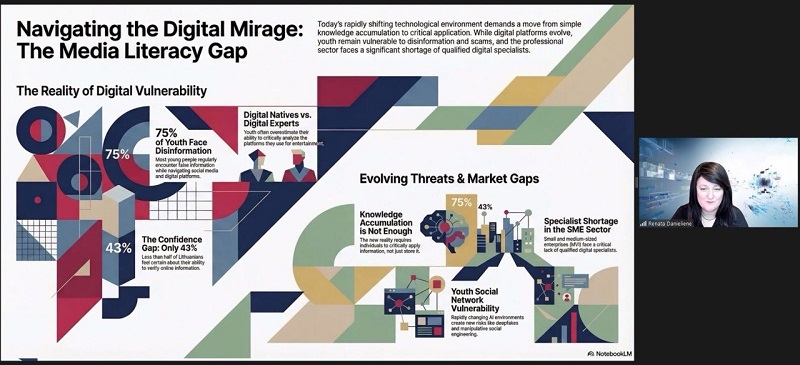
Renata Danieliene, PhD, Associate Professor at Vilnius University (Kaunas, Lithuania), presented a report titled "Cyber Security and Media Literacy: good practice examples." Ms. Renata presented the CyberRangeAgent project, which is coordinated by Vilnius University and brings together partners from various sectors — higher education, vocational education, small business, and associations. The project's target groups are higher education, vocational education, and small and medium-sized business employees. The materials can be implemented in educational institutions that train future specialists, as well as used by companies themselves, because today everyone is responsible for cybersecurity.
The next presentation was given by Edgaras Ščiglinskas, PhD, Head of the Multimedia Laboratory at Vytautas Magnus University (Kaunas, Lithuania), on the topic "Integrating Multimedia, AI, and Immersive Technologies in Educational Laboratories at Vytautas Magnus University." In his report, Edgaras Ščiglinskas revealed approaches to integrating innovative technologies into practical educational activities. In particular, he spoke about the work of the multimedia laboratory, where different types of media are combined to create interactive content, digital applications, and games involving both students and schoolchildren. The main goal of the laboratory's activities is the synthesis of theoretical knowledge and practical experience through teamwork on real projects.
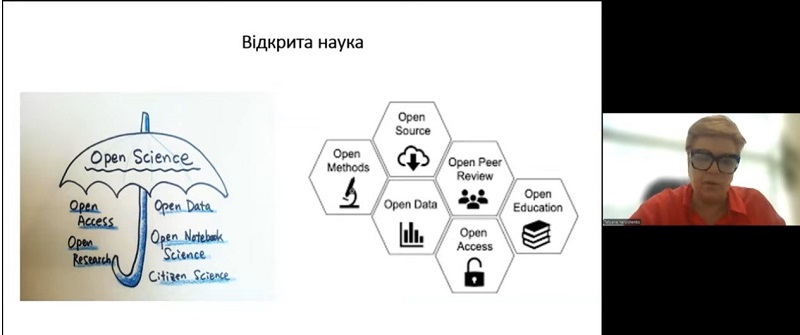
The report "Transformation of Open Science in Ukraine: Resilience and Innovation under Martial Law" was presented by Tetiana Yaroshenko, Deputy Director for International Cooperation in Scientific and Library Spheres at the State Scientific and Technical Library of Ukraine (Kyiv). She emphasized that, despite the systemic challenges caused by the war, the transformation of open science is actively taking place in Ukraine. According to her, the state is not only preserving its scientific potential but also taking strategic steps towards openness and integration into the European Research Area. The concept of open science, initiated in the EU in 2015, involves ensuring maximum accessibility of knowledge for society.
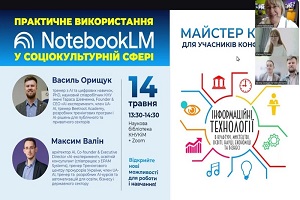
A series of master classes was also held within the framework of the conference. In particular, a practical workshop "Practical use of NotebookLM in the socio-cultural sphere" took place, conducted by Vasyl Oryshchuk, PhD, AI and digital skills trainer, founder of "AI-Experiment," and Maksym Valin, AI architect, co-founder and executive director of the same initiative. The speakers presented the possibilities of using artificial intelligence for automating work, creating content, and educational solutions.
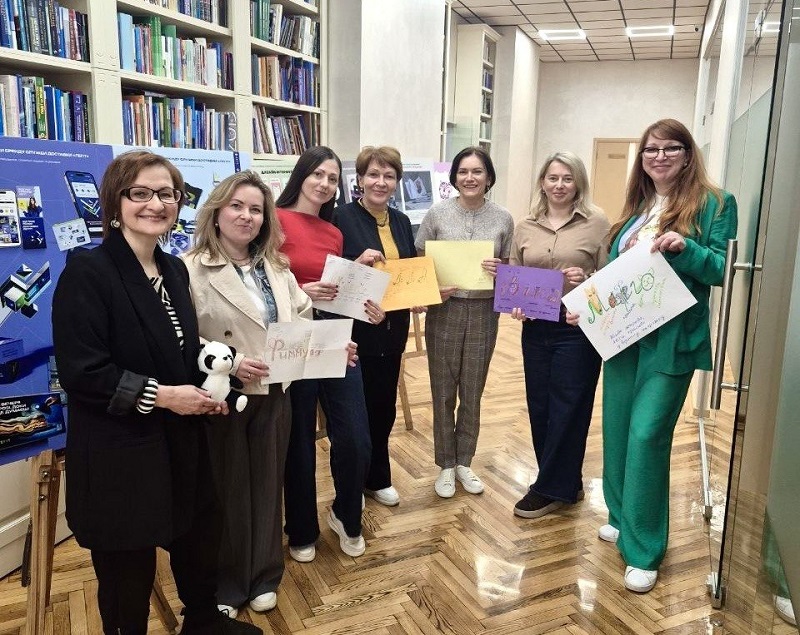
An art therapy master class "The Power of My Name: Personal Identification as an Indicator of Mental Resilience" was conducted by Maryna Bryl, Candidate of Psychological Sciences, Director of the State Scientific and Methodological Center for Content of Cultural and Artistic Education. The event was aimed at developing the psychological resilience and self-reflection of the participants.
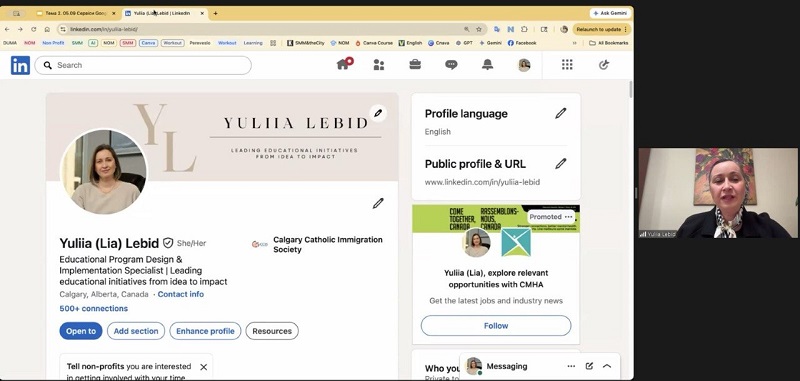
Special attention was drawn to the master class "LinkedIn as a Tool for Professional Positioning and International Professional Interaction," conducted by Yuliia Lebid, PhD, Program Facilitator, Information & Technology Bridging Program (Calgary Catholic Immigration Society, Canada). Participants learned about the possibilities of using the LinkedIn platform for building a professional reputation, networking, and career development in the global labor market, where digital presence is becoming an integral part of professional success.
Thus, holding international conferences at KNUKiM despite unprecedented security challenges has once again demonstrated the endurance and resilience of Ukrainian science and education. The event clearly demonstrated that the combination of digital innovations, artificial intelligence capabilities, and international partnership forms a reliable foundation for the development of scientific, educational, and creative spheres. Based on the results of the sections, a collection of materials will be prepared, which will summarize the current ideas and practical experience of the participants. Despite the enemy's attempts to disrupt the usual rhythm of life, the academic community is confidently holding the intellectual front, directing efforts towards innovative development and the reconstruction of Ukraine.